Deploying AI in business: the commando method
88% of companies are using AI, 39% are making an impact. What works: a hybrid commando integrated into teams, from CODIR to code.
Deploying AI in business: the commando method
In May 2026, OpenAI raised $4 billion to create a deployment company. Anthropic launched a $1.5 billion services joint venture with Blackstone and Goldman Sachs, after putting $100 million into its partner network in March. Mistral is targeting €1 billion in revenues by 2026, driven almost entirely by enterprise customers.
The labs understood something the market refused to see: value doesn't come from the model. It comes from implementation.
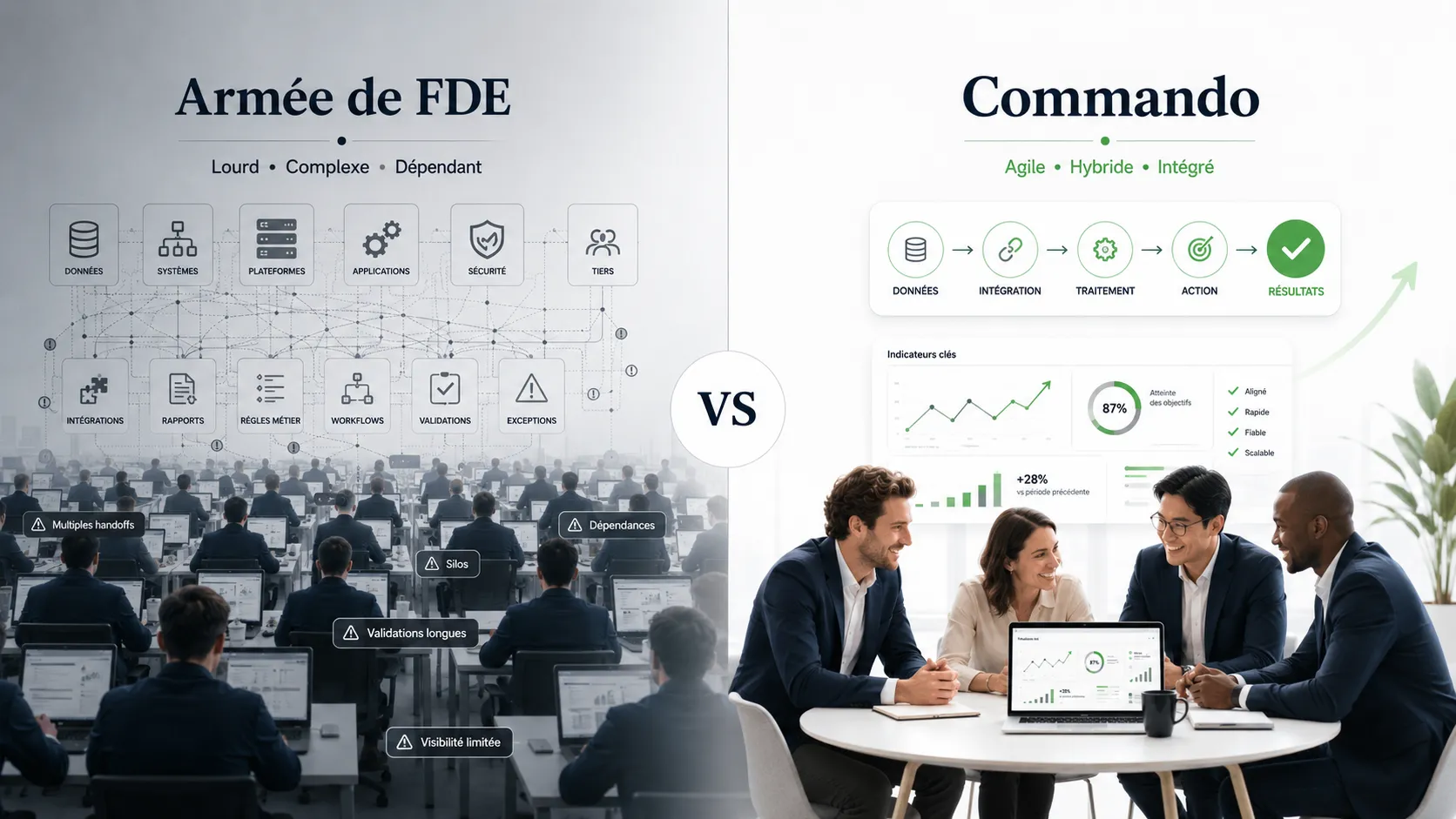
Their answer is the army. Hundreds of Forward Deployed Engineers sent to key accounts. It's better than an API. It's not your solution.
Because the processes these engineers are going to automate are 20 or 30 years old, and you can't change them with code. You change them with vision, governance and teams who understand both the business and the technology. In the field, it's not armies that transform companies. It's the commandos.
Here's why, with figures, and how it works in practice.
May 2026: AI labs put billions on deployment
Let's go back to the facts, dated and sourced, because they tell a specific story.
On May 11, 2026, OpenAI announces the Deployment Company. 4 billion in initial capital, raised from 19 firms, with TPG as lead investor alongside Advent International, Bain Capital and Brookfield. In the same move, OpenAI acquires Tomoro, an applied AI engineering firm bringing in around 150 deployment engineers from day one. Brad Lightcap, COO of OpenAI, sums up the intent: "Our customers tell us they need help to move from pilot to production."
A week earlier, on May 4, Anthropic launched its own AI services joint venture. Valued at $1.5 billion, with $300 million each committed by Anthropic, Blackstone and Hellman & Friedman, with Goldman Sachs as a founding partner. Target: portfolio companies of private equity funds. And this wasn't Anthropic's first move: in March 2026, the lab had already committed $100 million to its Claude Partner Network, along with Accenture, Deloitte, Cognizant and Infosys.
Mistral, for its part, has made B2B its central strategy. Arthur Mensch has announced a target of around 1 billion euros in revenues by 2026, after raising 1.7 billion euros in September 2025. His argument: to deploy AI in business, you need to master the whole stack, from model to integration.
Three labs, three different structures, one shared observation. Selling a model is no longer enough. Selling API access is no longer enough. What pays, and what will pay more and more, is the ability to make AI work in a real organization, with its existing processes, tools and teams.
We've been making this observation in the field since the beginning. What's new is that the most powerful players in the market have just validated it with their billions.
Forward Deployed Engineer: what it is and where it comes from
The job financed by these billions has a name: Forward Deployed Engineer, or FDE. If you've never heard of it, that's normal: it's only just entered the French vocabulary. It's about to settle in.
The model comes from Palantir, in the early 2010s. The company was working for American intelligence agencies that were incapable of writing conventional specifications: the need could only be understood by being on site. Palantir therefore sent its engineers directly to the customer's site, underwater. Internally, they were known as "Deltas". A revealing detail: until 2016, Palantir had more engineers deployed at customer sites than it had traditional software engineers.
Ten years later, the market has validated the model on a large scale:
- FDE job offers increased by800% between January and September 2025.
- On Indeed, FDE jobs in the United States rose from643 in April 2025 to 5,330 in April 2026.
- Salesforce has publicly committed to1,000 FDE around its Agentforce platform. Google Cloud is recruiting by the hundreds on four continents.
- The average remuneration for an FDE is around238,000 dollars in 2026 in the United States.
The principle of the FDE is sound: to put an engineer in touch with the field, where the need really exists, rather than behind a Jira ticket three intermediaries away. It's a real step forward from the "here's the API, you figure it out" model.
But the FDE answers the question "how do we make our technology work for the customer? It doesn't answer the customer's question, which is different: "how does my organization change, sustainably, with measurable results". And the gap between these two questions explains a good part of the figures that follow.
Why AI deployments fail (and it's not the models' fault)
The gap between adoption and value is now the best documented in the history of enterprise IT.
88% of organizations now use AI in at least one functionaccording to McKinsey's State of AI survey, published in November 2025 and involving 1,993 respondents in 105 countries. But in the same survey,only 39% reported an impact on operating income. And most of them estimate this impact at less than 5% of EBIT.
BCG arrives at the same place by a different route: in 2024,74% of companies had not yet demonstrated tangible value of their AI uses. Its 2025 edition still ranks60% of businesses in "laggardswith minimal gains.
Gartner warned as early as July 2024:at least 30% of generative AI projects abandoned after proof of concept by the end of 2025. Causes cited: data quality, insufficient risk controls, spiraling costs, blurred business value.
And then there's the figure you've probably already come across on LinkedIn: the MIT study according to which95% of generative AI initiatives produce no measurable return. Let's be precise, because this figure deserves better than its virality. It comes from a white paper by the NANDA project (MIT Media Lab, summer 2025), based on 52 interviews and 153 survey responses. It's not peer-reviewed, its definition of ROI is narrow, and it's been widely criticized for that. Don't quote it as an exact measure.
But read what the study actually says, because it's more interesting than its shock figure. The obstacle identified is neither model, nor infrastructure, nor regulation, nor talent. It's aboutintegration A secondary finding, almost buried in the report: most of the systems deployed do not retain feedback, do not adapt to the company's context, and do not improve over time. And a secondary observation, almost buried in the report: the projects carried outwith specialized partners are successful about 67% of the time, almost twice as often as in-house builds.
On the French side, the picture has its own color. According to INSEE,10% of French companies with more than 10 employees used AI in 2024compared with a European average of 13%. The June 2025 Bpifrance Le Lab survey of more than 1,200 SME and ETI managers adds two figures that tell the whole story:54% of user companies make do with free, generic toolsand in73% of cases, the impetus comes from the manager alone. In other words: surface tooling, carried by one person, with no anchoring in the teams. Exactly the type of project that doesn't survive its POC.
To sum up. The models work. Adoption is massive. And yet the value isn't there, because the missing link isn't technological or budgetary. It's organizational.
The labs' answer: armies. The limit: your land.
Faced with this situation, the labs' response is consistent with what they are: very large-scale structures. Thousands of FDEs, partnerships with the big four consulting firms, joint ventures with the world's biggest funds. Anthropic's JV explicitly targets Blackstone and Hellman & Friedman portfolio companies. OpenAI's Deployment Company kicks off with TPG, Bain and Goldman around the table.
Look at who gets served first: key accounts and private equity portfolios. That's logical, since that's where the biggest contracts are. But that leaves a whole question for the rest of the economic fabric: who deploys, and how?
And even at major accounts, the deployed engineer model has structural limits that no budget can correct:
An isolated FDE creates a dependency, not a capacity. He keeps his employer's technology running. The day he leaves, the skill leaves with him. No transfer has taken place, because transfer is not his mission.
A single engineer cannot carry out a transformation. The business processes he encounters have 20 or 30 years of history, special cases and habits. Changing them requires legitimacy with the CODIR, a detailed understanding of the business and governance. It's not an engineering mission, it's a team mission.
The FDE's incentive is not yours. OpenAI FDE deploys OpenAI. A Salesforce FDE deploys Agentforce. The question "is this the right tool for this process" is not part of his job description.
The model reproduces the error of one-shot training. We've already tried to transform companies by sending in one-off experts: the AI seminars of 2023-2024 produced sensitized employees and unchanged processes. A passing expert, whatever his or her level, doesn't change an organization.
The labs' diagnosis is right: value lies in deployment. Their response is tailored to their customers: armies for empires. It remains to be seen what works for an organization that has neither 50,000 employees nor a PE fund in its capital.
The commando method: 2 to 4 hybrid profiles, from CODIR to code
What works in the field, we've seen repeated mission after mission, and it's the opposite of an army. It's a commando:a team of 2 to 4 hybrid profiles, business and technological experts, led by a head of AI, working in co-construction with your internal teams. From CODIR to lines of code.
In concrete terms, here's what's changed, point by point.
Size is a feature, not a constraint. With 2-4 people, the commando is integrated into your teams rather than superimposed on them. No 15-person project committees, no three-month-long framing slides. Decisions are made quickly, because the decision-makers are in the room, and each member is augmented by AI in his or her own work: the team's productivity has nothing to do with its size.
Hybrid means bilingual. Each topic is addressed by someone who understands the business process AND what the technology can do with it. This is precisely the missing link identified by all the studies cited above: failure doesn't come from the model, it comes from the junction between the model and the business. The commando lives at this junction.
A head of AI links the CODIR to the field. Transformation needs a leader who speaks to both floors: the one who arbitrates vision and governance with management, and the one who decides technical choices with the teams. Without such a role, AI projects float between a cautious CIO and helpless business units, and return to the purgatory of POCs.
Co-construction is the key to adoption. The commando doesn't deliver a tool to your teams: he builds it with them. Receptionists, managers and operators are involved in the choices right from the start. The result: the tool follows the real process, not the theoretical one, and the teams adopt it because it's theirs too. This is the exact antidote to the 54% of generic tools identified by Bpifrance.
The transfer of competence is part of the moral contract. At the end of the mission, your teams know how to operate, adjust and extend what has been built. Commando makes the company more capable, not more dependent. It's the difference between hiring an army and training your own.
The horizon is 4 to 6 months, not 3 years. First measurable indicators, tools actually adopted, teams expanded. Not a promise of transformation on the horizon of the next strategic plan: results that can be read in a dashboard before the end of the half-year.
FDE army, firm, freelance or commando: the comparison
The FDE army (the lab model)
- Thought for : key accounts and private equity portfolios
- Profiles Lab engineers: variable, often large numbers
- Link with techno : deploys his employer's stack, by construction
- Transfer of competence not planned, this is not the mission
- After departure a long-lasting dependence on lab
The consulting firm
- Designed for : key accounts and strategic framing projects
- Profiles : project team plus management, often supervised juniors
- First measurable results after the scoping phase, rarely before
- Transfer of competence limited to deliverables
- After departure A report and recommendations for implementation
The AI freelancer
- Designed for technical tasks
- Profiles one person, usually technical
- First measurable results fast, but on a narrow perimeter
- Transfer of competence : rare
- After departure : a dependence on the individual
The hybrid commando
- Designed for SME, ETI and group business units
- Profiles 2 to 4 hybrid business + tech profiles, led by a head of AI
- First measurable results 4 to 6 months
- Link with techno : independent of publishers, chooses tool for process
- Transfer of competence at the heart of the method
- Integration with existing systems a condition for success, not an option
- After departure : autonomous teams using the tool
This comparison is not a trial of other models: a multinational that standardizes usage across 40,000 workstations needs an army, and some issues can be solved very well with a good freelancer. The question lies elsewhere: what does your terrain look like, and which model can really operate in it?
Case in point: 80 rooms, and counting hours disappearing
A real-life example, anonymized at the customer's request: an independent hotel with around 80 rooms and sales of around 2 million euros.
The problem. As in many establishments of this size, cash was a blind spot. Check-in, check-out, currency conversions for foreign customers, cash withdrawals: everything was counted by hand, without centralization or confidence intervals. The classic consequences: unexplained discrepancies, outright losses, and above all zero consolidated visibility of receipts and payments at hotel level. Management knew it. No one had the time to tackle it, and solutions on the market required either a cumbersome cash register, or an additional data entry process for already overburdened receptionists.
What the commando did. With them, we built CashTrack, an innovativecustomized web application for continuous monitoring of cash inflows and outflows, designed for the reality of a hotel reception: data entry is done by voice, in writing or at the touch of a button, in a matter of seconds, between two customers. Currency conversions are calculated by the tool. Management has access to apermanently consolidated global counting.
The turning point, and this is the heart of the method: integration with existing systems. The non-negotiable condition was that CashTrack would plug into the software suite already in place, without imposing a new, cumbersome process on all receptionists. This is exactly the invisible work that makes the difference between an adopted tool and a dormant license. The day that data entry became faster than the old manual count, adoption ceased to be an issue.
The results. 3 to 5 hours saved each week for management and the receptionist on counting and reconciliations. A confidence interval on the cash desk, where there were only approximations. And an effect that we hadn't included in the specifications: staff began to look at cash flows differently, because the tool makes entries and exits visible as they happen. The awareness that repeated instructions had never achieved, a well-integrated tool produced in a matter of weeks.
No robots in the lobby. No announcements. Hotel guests will never know that an AI is working the front desk, and that's just fine: useful AI is that which feels at home in the margins without ever showing its face.
Where to start
If you recognize yourself in POC purgatory, or want to avoid it, here's where we recommend you start, whether with us or not:
- Invent pain, not technology. The right starting point is never "what can we do with AI" but "where do we lose time, money or reliability every week". That's where anyprocess automation profitable. The above hotel cash is a textbook case: weekly, measurable, bounded pain.
- Choose a perimeter that a commando can hold. A process, identified users, a success indicator defined before writing the first line of code.
- Insist on integration with existing systems. Any tool that adds a process instead of lightening one will be bypassed. This is the first question to ask any service provider.
- Put the job in the team, not at the end of the chain. If future users discover the tool on delivery, you've already lost.
- Give yourself 4 to 6 months and a scorecard. No indefinite transformation: readable indicators before the end of the half-year, and an extension decision based on them.
An FDE in isolation won't transform your business. One-shot training has not worked for the same reason. The billions from the labs have just validated the diagnosis: it's all about implementation. In the field, implementation has a shape: small, hybrid, integrated, measurable.
If you think about your transformation model,let's talk.
FAQ: AI deployment and the commando method
What is a Forward Deployed Engineer (FDE)? An engineer employed by a technology company (originally Palantir, now OpenAI, Anthropic, Google, Salesforce) and deployed directly at the customer's site to run their employer's technology. The role has been booming since 2025, with offers increasing by 800% in nine months.
What's the difference between an FDE and a hybrid commando? The FDE is a single engineer, whose mission is to deploy his employer's stack. The commando is a team of 2 to 4 people with a mix of business and technological expertise, independent of vendors, whose mission includes governance, co-construction with your teams and skills transfer.
Why do so many AI projects fail after the POC? Because the weak link is not the model, but integration: tools disconnected from actual processes, teams not involved, lack of governance and indicators. Gartner predicted that at least 30% of GenAI projects would be abandoned after the POC; McKinsey measures that 88% of organizations are using AI, but only 39% are making an impact on their bottom line.
How long before measurable results? With a well-defined scope and a team integrated into the business, the first measurable indicators arrive in 4 to 6 months: time saved, error rate, process reliability. That's the horizon we've set ourselves.
Do you need to be a large company to deploy AI seriously? No, and this is the current market blind spot: the offensives of the labs (OpenAI Deployment Company, Anthropic-Blackstone JV) target large accounts and private equity portfolios. The commando model is precisely designed for SMEs, ETIs and business units, which will never have an army of FDEs.
Does the tool have to replace our existing software? Not at all. The number-one condition for adoption is integration with your existing software suite, without any additional processes imposed on your teams. A tool that adds to the burden will be bypassed, no matter how good its technical quality.
What happens to the system when the mission is over? The transfer of skills is part of the method: your teams know how to operate, adjust and extend what has been built. The aim is to make the company more capable, not more dependent on the service provider.
What about compliance (RGPD, sensitive data)? It must be dealt with from the outset, not as an afterthought: choice of hosting and models compatible with your constraints, minimization of data processed, and documented governance. This is one of the roles of the head of AI, who leads the commando team.
Sources
- OpenAI, "OpenAI launches the Deployment Company", May 11, 2026
- Anthropic, "Enterprise AI services company" (Blackstone / Hellman & Friedman / Goldman Sachs JV), May 4, 2026; "Claude Partner Network", March 12, 2026
- CNBC, "Anthropic, Goldman, Blackstone AI venture", May 4, 2026
- Maddyness, "Mistral AI on track to reach one billion euros in revenue by 2026", January 23, 2026
- Fast Company, "Postings for this AI job are up 800%", 2025
- McKinsey, "The State of AI" (March and November 2025 editions, n = 1,993, 105 countries)
- BCG, "Where's the Value in AI?" (October 2024); "The Widening AI Value Gap" (September 2025)
- Gartner, press release dated July 29, 2024 (post-POC abandonment)
- MIT NANDA, "The GenAI Divide: State of AI in Business 2025" (July 2025), cited with methodological limitations
- INSEE, TIC entreprises 2024 survey (Insee Première no. 2061, July 2025)
- Bpifrance Le Lab, "L'AI dans les PME et ETI françaises : une révolution tranquille", June 2025 (n > 1,200 executives)